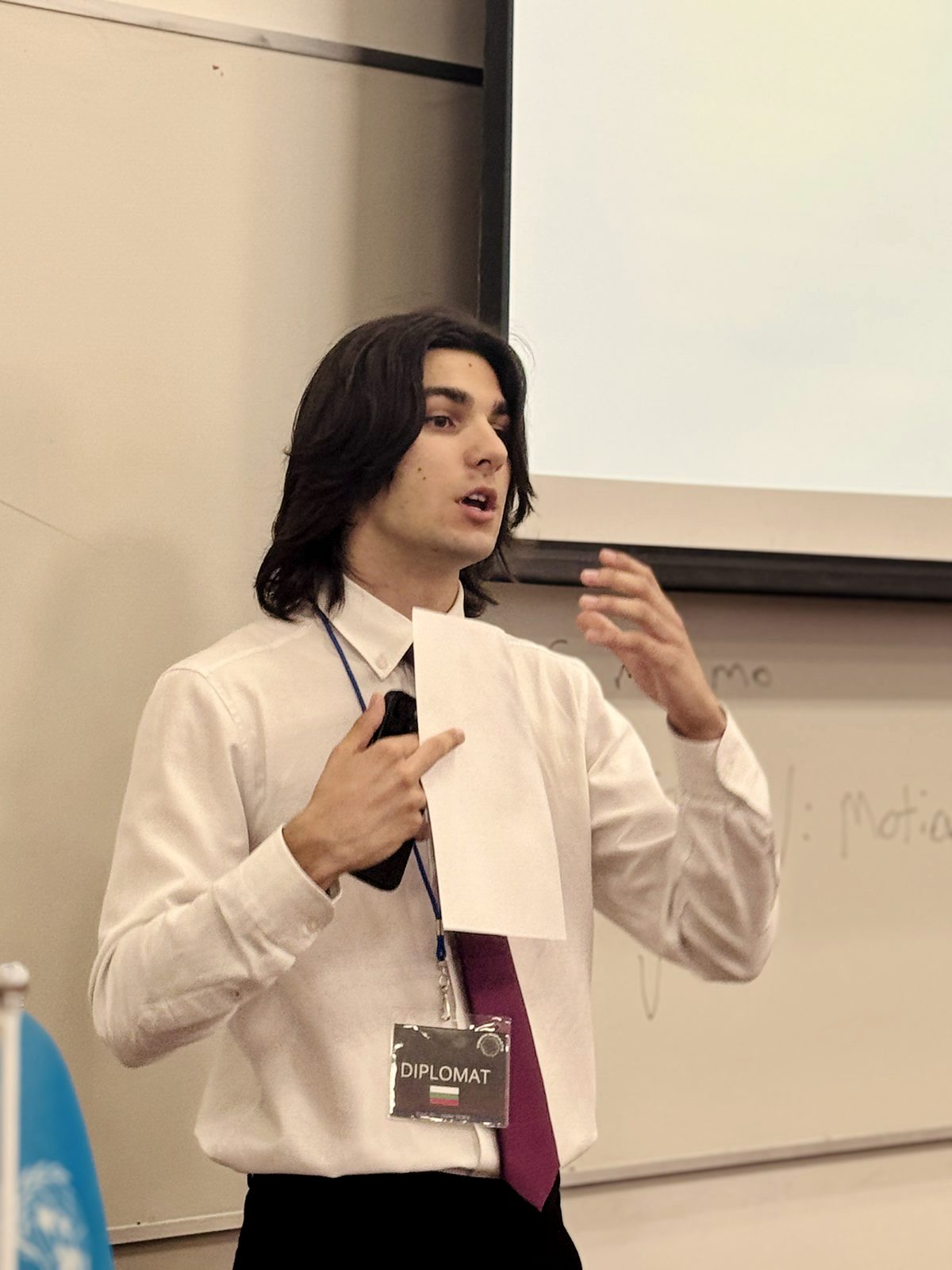
Model UN and entrepreneurship reward the same habits: understanding the other side's constraints, drafting text that other people can sign, building a coalition before the vote, and taking a position you are willing to revise on evidence. A good delegate is already practising the working method of a good founder, whether or not they ever start a company.
Key takeaways
- The core skills of a strong Model UN delegate, listening for constraints, drafting for agreement, building coalitions and revising on evidence, are the same skills that early-stage founders use every week.
- Customer discovery is caucusing with a different name; a term sheet is a draft resolution; a co-founder search is bloc formation.
- The Global 60 Founder Lab is about 75 minutes on Saturday: a founder's practical story followed by the Problem Marketplace. It is not a startup conference or a pitch competition.
- Delegates who form a team in the Problem Marketplace can keep working together through the Global 60 Network, which includes Founder Lab team continuation and a ninety-day check-in.
- You do not need a business idea to benefit. The Founder Lab is about learning how founders find and frame problems, which is useful in any career.
- Why Model UN and entrepreneurship use the same habits
- Habit one: understand the other side's constraints
- Habit two: draft text that people can sign
- Habit three: build the coalition before the vote
- Habit four: take a position, then revise it on evidence
- Three parallels, side by side
- What the Global 60 Founder Lab is, and is not
- How to keep working with a team afterwards
- Where to go next
Why Model UN and entrepreneurship use the same habits
Model UN and entrepreneurship both ask a young person to make progress with people they do not control. A delegate cannot order another country to vote for a clause; a founder cannot order a customer to buy, an engineer to join or an investor to write a cheque. Both have to earn agreement.
That single constraint produces a shared set of habits. In committee they are called diplomacy skills; in a company they are called sales, product and leadership.
This matters for student founders in particular, because most first-time founders fail at the human parts of the job long before the technical parts. They build before they listen, pitch before they ask, and confuse a polite nod for a commitment. A season of Model United Nations (Model UN, MUN) is an honest and inexpensive way to unlearn those instincts early.
Habit one: understand the other side's constraints
The first founder habit that Model UN teaches is to find out what the other person cannot do before you ask them for anything. A delegate representing a small island state and a delegate representing a major oil exporter are not being difficult when they disagree on emissions language; they are each carrying instructions from a capital, an economy and a domestic politics they did not choose.
Good delegates research those constraints before the first session. They read the country's recent statements, look at how it voted last time and notice which phrases it avoids. By the time they approach that delegate in an unmoderated caucus, they already know which requests are possible and which are not. Our training guide on researching your country walks through that process step by step.
Founders call this customer discovery. Before writing code, a disciplined founder interviews the people who have the problem, asks how they cope with it today, what they have already tried and what budget or authority they actually hold. The rookie mistake is identical in both rooms: assuming the other side is free to say yes.
What this looks like in practice
- In committee: asking "what would your delegation need to see in operative clause three?" rather than "will you support our draft?"
- In a company: asking "walk me through the last time this went wrong" rather than "would you use an app that fixed this?"
- In both: writing down what you heard, not what you hoped to hear.
Habit two: draft text that people can sign
The second habit is writing for agreement rather than for applause. A draft resolution exists to be adopted, and a draft that reads beautifully but cannot attract a majority has failed at its only job.
Experienced delegates learn to write clauses that give each bloc something it can defend at home: a preambular recognition here, a softened verb there, a reporting mechanism that lets the cautious countries say yes without committing to a deadline. Our draft resolution guide covers the structure; the harder lesson is the temperament, which is to hold the objective firmly and the wording loosely.
A term sheet, a partnership agreement or a job offer is the same document under a different heading. It has to be specific enough to mean something and flexible enough that the other party can sign it without feeling defeated. Founders who have never had to negotiate a resolution often write terms that are perfect for themselves and unsignable for anyone else, and then wonder why the deal stalls.
Habit three: build the coalition before the vote
The third habit is that the vote is decided before the vote. In Model UN, the delegate who waits for the formal count to discover where support lies has already lost; the work of a coalition happens in the corridor, the unmoderated caucus and the shared document, long before the chair calls for a show of placards.
Bloc formation is patient and slightly unglamorous. You identify who shares your interest, who shares part of it, and who can be persuaded by a change of wording rather than a change of position. You give credit generously, so that other delegations feel ownership of the text. Our guide to lobbying and caucusing explains the mechanics, and the sibling article on the skills employers value shows why recruiters look for exactly this.
A founder building a team, a customer pipeline or an investor round is doing the same thing. The co-founder search is bloc formation: you are looking for someone whose skills are complementary, whose interest in the problem is genuine and whose commitment survives a hard week. The first ten customers are a coalition too, assembled one conversation at a time before anyone has seen a launch.
Habit four: take a position, then revise it on evidence
The fourth habit is the discipline of committing to a view and then changing it when the facts change, without losing face or losing the plot. A delegate opens with a position paper and a speech; by the end of the second session, the good ones have amended their own text three times because the room taught them something.
Founders live inside the same loop. They state a hypothesis about a customer and a problem, they build the smallest thing that tests it, and they read the result honestly. Well-known ideas in early-stage business, from the minimum viable product to the pivot, are simply names for the habit a good delegate already has: state your case, gather evidence, revise, repeat. Our negotiation tactics module covers how to concede a point without conceding the outcome.
Three parallels, side by side
The clearest way to see the overlap between negotiation skills for entrepreneurs and the skills of a delegate is to line up the activities directly.
| In committee | In an early-stage company | The shared skill |
|---|---|---|
| Caucusing: finding out what each delegation needs before drafting | Customer discovery: interviewing users before building | Listening for constraints, not for agreement |
| Draft resolution: text that a majority can adopt | Term sheet or offer: terms both parties can sign | Writing for agreement |
| Bloc formation: assembling support before the vote | Co-founder search and first customers: building a team and a pipeline | Coalition-building |
| Amending your own clause after debate | Pivoting after a failed test | Revising on evidence |
None of this means every delegate should start a company. It means the delegate who takes committee seriously is acquiring a transferable method.
What the Global 60 Founder Lab is, and is not
The Global 60 Founder Lab is a session of about 75 minutes on the Saturday afternoon of The Global 60, placed between the second committee session and the gala, in which delegates hear a founder's practical story and then take part in the Problem Marketplace. It is the second of the programme's four pillars, alongside The Assembly, the gala and New York.
The first part is a practical story rather than an inspirational talk. A founder explains how they identified a problem, how they validated that other people had it, how they found customers, what the basic economics looked like, how the early team came together and what execution actually involved. The emphasis is on method, not on personality.
The second part is the Problem Marketplace. Delegates move around the room by problem area, currently AI, education, health, climate, finance, media, social impact and consumer products, and find the people who care about the same problems they do. The premise is simple: your future co-founder may already be in the room, and the fastest way to find out is to talk about a problem rather than an idea.
What it is not
- Not a startup conference. There are no exhibitor stands, no panels and no keynotes about the future of technology.
- Not a pitch competition. Nobody presents a deck, nobody is scored and no funding is awarded.
- Not an academic advantage. Taking part has no bearing on committee assignments, speaking time, awards or recognition, and it is identical on every tier.
By Saturday afternoon, delegates have already spent two committee sessions practising the four habits above; the Founder Lab asks them to notice it. The session outline is on the Founder Lab page and the programme page.
How to keep working with a team afterwards
Teams that form in the Problem Marketplace can keep working together through the Global 60 Network, which is what Youth Impacts offers after New York. The network is a private community for those who complete the programme, with a ninety-day check-in, Founder Lab team continuation, one virtual gathering in the following year and introductions where they are available.
Founder Lab team continuation is the part that matters here. A group that found each other on Saturday afternoon is encouraged to set a small, concrete next step before Sunday, for example three customer conversations each, or a shared document describing the problem in one page, and to report back at the ninety-day check-in. The aim is modest and realistic: keep the conversation alive long enough to find out whether the problem is real.
A few habits help a new team survive the return to school or university:
- Agree the problem, not the product. Teams that commit to a solution too early tend to fall apart when the first test fails.
- Set a cadence you can keep. A thirty-minute call every two weeks beats an ambitious weekly plan that dies in the first exam period.
- Run the caucus again. Talk to people who have the problem, write down their constraints and revise. It is the same loop you practised in committee.
- Ask for introductions honestly. Where the network can connect you with someone useful, be specific about what you want to learn, not what you want to sell.
Where to go next
If you want to see how the four habits are taught, start with the free Youth Impacts training curriculum, particularly the modules on diplomacy skills and leadership in committee. For the programme itself, the Founder Lab page describes the Saturday session, and admission and fees explains how to apply for the Founding Class of 2027.
Frequently asked questions.
Do I need a business idea to benefit from the Founder Lab?
No. The Founder Lab is about how founders find and frame problems, not about pitching ideas. Delegates with no interest in starting a company still learn a method that is useful in any career.
Is the Global 60 Founder Lab a pitch competition?
No. Nobody presents a deck, nothing is scored and no funding is awarded. It is about 75 minutes on Saturday: a founder tells a practical story, then delegates take part in the Problem Marketplace.
What is the Problem Marketplace?
The second half of the Founder Lab, in which delegates gather by problem area (AI, education, health, climate, finance, media, social impact, consumer products) and find the people who care about the same problems.
Does taking part in the Founder Lab affect committee assignments or awards?
No. The Founder Lab has no bearing on country assignment, speaking time, committee role, awards or recognition, and it is identical on every tier.
How can a team keep working together after The Global 60?
Through the Global 60 Network, which includes Founder Lab team continuation, a ninety-day check-in, one virtual gathering in the following year and introductions where available.
Which Model UN skills transfer most directly to entrepreneurship?
Understanding the other side’s constraints (customer discovery), drafting text people can sign (term sheets and offers), building a coalition before the vote (co-founders and first customers) and revising a position on evidence.

Youth Impacts is a Model United Nations organisation. Its flagship New York experience is The Global 60: sixty delegates, three small chambers, 22 – 25 April 2027, admission by application and interview. Youth Impacts Model United Nations (YIMUN) has run since 2025. Questions: info@youthimpacts.com. Published 19 September 2026.