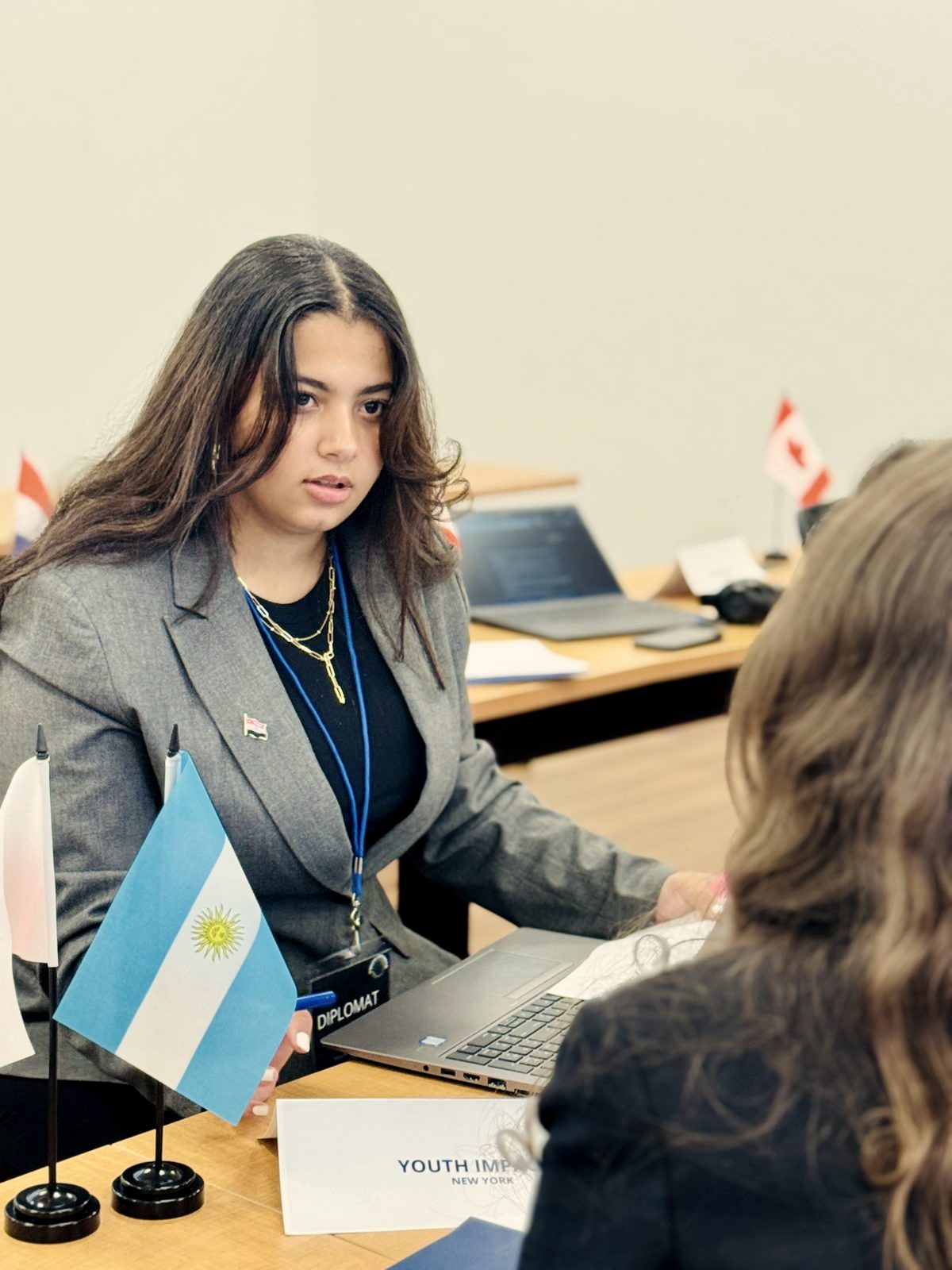
Model UN on college applications is persuasive when it shows four things a reader can verify: sustained commitment over time, visible growth, initiative beyond attendance, and concrete evidence such as a drafted resolution, a chaired committee or a named award. A list of conference names shows none of them.
Key takeaways
- Admissions readers look for sustained commitment, growth, initiative and evidence; Model UN provides all four only if you describe what you did, not what Model UN is.
- A strong activity description leads with a verb, names a specific responsibility and includes one verifiable detail, all inside the character limit.
- The best Model UN essays are about one moment in one committee, not about diplomacy in general.
- List awards exactly as the conference named them, with committee and year; honesty about an Honourable Mention reads better than vagueness about a gavel.
- For UCAS, connect each Model UN skill to the specific course; the current three-question format asks directly how experience outside education prepared you.
- Small-cohort programmes that give you real responsibility and specific feedback produce the concrete material that applications need.
- What do admissions readers look for in Model UN?
- How do you put Model UN on a resume or CV?
- How to write the Model UN Common App activity description
- How to use Model UN in a personal statement without clichés
- How to list Model UN awards honestly
- Model UN in a UCAS personal statement
- Where does the concrete material come from?
- Where to go next
What do admissions readers look for in Model UN?
Readers look for evidence that you stayed with something, got better at it, made something happen that would not have happened without you, and can prove it. Model UN is common on applications, which means the reader is not impressed by the activity itself; they are looking at what you did inside it.
- Sustained commitment. Two or three years in the same club, with responsibilities that grew, is a stronger story than one conference in each of five cities.
- Growth. Readers like a trajectory: a first conference where you barely spoke, a second where you sponsored a clause, a third where you trained the new delegates.
- Initiative. Founding a club, chairing a committee, organising a conference, writing the topic guide, or building a training programme all show that you did more than turn up.
- Evidence. A resolution that passed, a committee you chaired, a delegation you led, an award named with its committee, or written feedback from a chair. Anything a sceptical reader could, in principle, check.
The application is not a place to explain what Model United Nations (Model UN, MUN) is. Assume the reader knows and spend every character on your part in it. If you need the general case for the activity, our essay on whether Model UN is worth it makes it; the application should not.
How do you put Model UN on a resume or CV?
Put Model UN under activities or leadership as a two-line entry: the first line gives the organisation, your role and the dates, and the second gives one or two specific outcomes with verbs at the front. Do not write a paragraph, and do not list every conference.
A weak entry reads: “Model UN Club, member, 2024–2026. Attended several conferences and won awards.” A strong entry reads: “Model UN Society, Head Delegate, 2024–2026. Trained a delegation of twelve first-year delegates; drafted the resolution adopted in a Human Rights Council simulation; Outstanding Delegate, ECOSOC, 2025.”
The difference is not length. The strong entry has a title that implies responsibility, a number that can be checked, a specific outcome and an award named with its committee and year. Adapt the same pattern for a Model UN CV in the UK, where the section is usually headed “Positions of responsibility” or “Extra-curricular”. Our companion piece on the skills employers value shows how the same line evolves for a first job.
How to write the Model UN Common App activity description
Write the 150-character activity description as a compressed version of the strong CV line: verb first, one concrete responsibility, one verifiable detail, no definition of Model UN. The activity name and position fields carry the labels, so the description should carry only what you did.
Here is one activity taken through three drafts. Each fits within 150 characters.
| Draft | Description | Why it reads that way |
|---|---|---|
| Weak | Participated in Model UN conferences representing different countries and learned about international relations and public speaking. | All activity, no outcome; the reader learns nothing that distinguishes you from every other delegate. |
| Better | Represented six countries at regional conferences; won Honourable Mention twice; helped run weekly practice sessions for new members. | Concrete and honest, but “helped run” hides the actual responsibility and the awards do more work than the leadership. |
| Strong | Led weekly training for 15 new delegates; drafted the resolution adopted in a UNHCR simulation; Outstanding Delegate, ECOSOC, regional conference. | Three verbs, one number, one outcome, one award named with its committee. Every clause is checkable. |
Two habits help. Write the long version first, then cut, rather than trying to compress from the start; and read the final line aloud to check that it still sounds like a person, not a telegram. Semicolons are your friend inside the limit.
What to leave out
The words “Model UN”, “conference”, “delegate” and “international relations” are already implied by the activity name. Every one you cut buys room for a verb or a number.
How to use Model UN in a personal statement without clichés
Use Model UN in an essay by writing about one specific moment in one committee and what it changed in how you think, rather than about Model UN as an activity. The cliché essays all describe the activity; the memorable ones describe a decision.
Readers have seen many versions of the same three essays: “I learned to see both sides”, “I found my voice behind the placard”, and “I realised the world is complicated”. They are not wrong, but they are interchangeable, and an interchangeable essay does not help you.
Better raw material is smaller and stranger. The clause you wrote at midnight and had to abandon at nine the next morning because the country you represented would never have accepted it. The delegate you disliked whose amendment made your resolution better. The moment you stopped speaking for your country and started speaking for yourself, and how the chair’s written note afterwards named exactly that.
- Start inside the scene. A room, a clause, a time on the clock. No preamble about what Model UN is.
- Show the decision. What you had to choose between and what it cost.
- Move outward once. One paragraph on what the decision taught you about how you work, argue or listen.
- Land somewhere specific. What you do differently now, in a setting that is not Model UN.
The diplomacy skills module in the Youth Impacts curriculum describes the habits most worth writing about, because they are the ones that transfer.
How to list Model UN awards honestly
List every award exactly as the conference named it, with the committee and year, and never inflate a lower award into a vaguer higher one. An Honourable Mention in a named committee is a real, checkable achievement; “award-winning delegate” with no detail invites the reader to assume the least.
The standard ladder is Best Delegate, Outstanding Delegate and Honourable Mention, plus Best Position Paper for written work; our guide to Model UN awards explains how each is decided. Because awards are given per committee, the committee name matters as much as the award. “Best Delegate, Security Council” and “Best Delegate, a 200-seat General Assembly committee” are both real, and both should be described as they were.
If you have no awards, say nothing about awards and put the space into responsibility and outcomes. Readers do not count gavels. Many of the strongest Model UN applications describe delegates who chaired, trained and organised rather than delegates who won.
Model UN in a UCAS personal statement
In a UCAS personal statement, Model UN belongs in the answer about how experiences outside education have prepared you for the course, and it works only when each skill is tied to the specific subject you are applying for. UK readers are academic selectors, and they are asking whether you can do the degree.
The UCAS statement moved to a structured three-question format for recent entry cycles: why you want to study the course, how your studies have prepared you, and what else you have done to prepare and why it is useful. Check the current wording on the UCAS website before you write, as details can change between cycles. Model UN sits in the third answer, and the discipline is the same as in the activity description: verb, responsibility, evidence, then one sentence on why it matters for this course.
- Politics and international relations. Researching a state’s voting record and writing a position paper is close to the reading and argument the course requires; say so.
- Law. Drafting operative clauses, amending under time pressure and arguing procedure map directly onto legal drafting and advocacy.
- Economics. Negotiating a financing mechanism in committee is a small version of the trade-offs the course studies.
- Languages and area studies. Representing a country whose language you are learning, and reading its primary sources, is a concrete link.
Keep the Model UN section short. One well-chosen example with a clear link to the course does more than a list of conferences, and the character limit rewards precision.
Where does the concrete material come from?
The concrete material comes from programmes where you had real responsibility and where someone told you specifically what you did well and badly. Large conferences give you the name of a city; small ones with attentive chairs give you sentences you can quote.
This is the practical case for choosing at least one small-cohort programme. In a chamber of about twenty delegates, the chair sees every speech, every caucus and every clause you write, so any feedback you receive is about you rather than about the room. A single specific observation from a chair, a note that you conceded a point at exactly the right moment or that your third speech was the one that moved the bloc, is exactly the kind of detail an essay or a UCAS answer needs. Our guide to choosing a Model UN conference covers what else to look for.
The Global 60, presented by Youth Impacts in New York City on Thursday 22 – Sunday 25 April 2027, is built on that principle: sixty delegates in three chambers of approximately twenty, three committee sessions and a Global Plenary, with four academic awards per chamber and five cohort recognitions read at the gala. High-school and university delegates share the chambers, awards are separated between the two tracks where necessary, and no tier affects country assignment, speaking time, committee role, awards or recognition. It is described in full on The Assembly page, and the admission page explains the application and interview.
Whatever programme you choose, keep a file from the first conference onwards: position papers, draft resolutions, chair feedback, the award certificate with its committee name. Applications are written a year or two after the events they describe, and memory is a poor archivist.
Where to go next
If you are building the record now, the free Youth Impacts training curriculum and the module on leadership in committee show how to take on the responsibilities readers notice. Parents and counsellors will find the practical questions answered on the parents page, and delegates who want a small-chamber conference to write about can read how to request admission to The Global 60.
Frequently asked questions.
Does Model UN look good on college applications?
It can, but only when the application shows sustained commitment, growth and initiative rather than a list of conferences attended. One well-described year of real responsibility is worth more than five conference names.
How do I put Model UN on a resume or CV?
List it as an activity with your role, the years involved, and one or two specific outcomes: a resolution you drafted, a committee you chaired, a delegation you trained, an award named honestly with its committee. Keep it to two lines.
How should I write the Model UN Common App activity description?
Use the 150 characters for what you did and what changed because of it, not for the definition of Model UN. Lead with a verb, name a concrete responsibility, and include one measurable or verifiable detail.
Can I write my personal statement about Model UN?
Yes, if the essay is about a specific moment and what it taught you, rather than about Model UN in general. Readers have seen many essays about “learning to see both sides”; they have seen few about a particular clause a delegate had to abandon and why.
Should I list an Honourable Mention or only Best Delegate?
List any award you received, named exactly as the conference named it, with the committee and year. Never round an Honourable Mention up to “award-winning delegate” without saying which award; readers notice, and honesty is itself a signal.
Does Model UN help with a UCAS personal statement?
It can, particularly for courses in politics, international relations, law, economics and languages, where the current UCAS questions ask how experiences outside education prepared you. Link the skill to the course explicitly rather than assuming the reader will.

Youth Impacts is a Model United Nations organisation. Its flagship New York experience is The Global 60: sixty delegates, three small chambers, 22 – 25 April 2027, admission by application and interview. Youth Impacts Model United Nations (YIMUN) has run since 2025. Questions: info@youthimpacts.com. Published 19 September 2026.