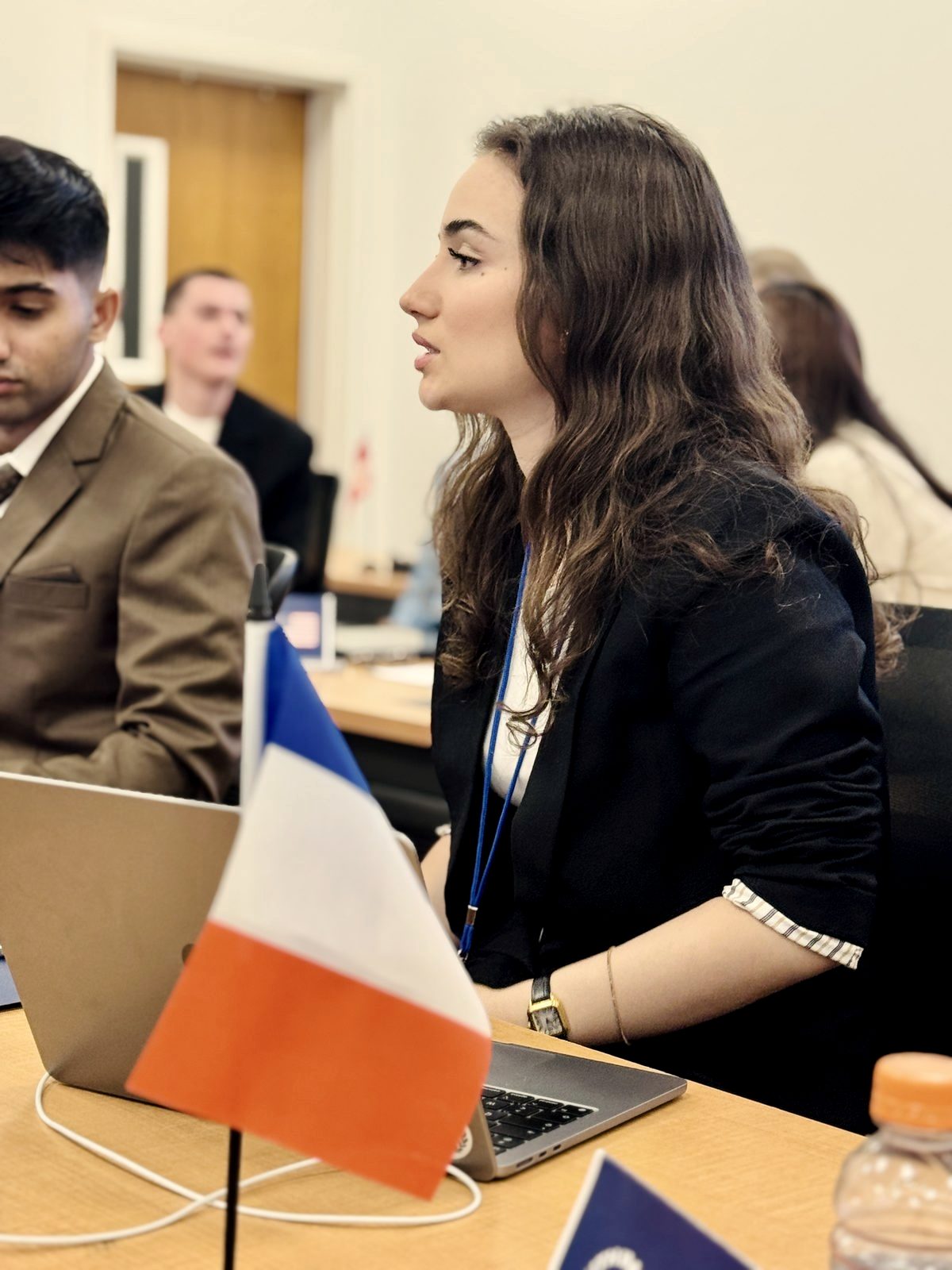
Model UN interview questions are designed to find out five things: whether you are curious about the world, whether you can hold a position under polite pressure, whether you listen, why you actually want to come, and whether you are ready to travel and live alongside strangers for a few days. Almost every question a selective programme asks is one of those five in disguise.
Key takeaways
- A selective Model UN programme is assessing curiosity, the ability to hold a position, listening, motivation and readiness to travel, not existing expertise.
- No Model UN experience is required for most selective programmes; interviewers want to see how you think, not what you already know.
- Strong answers are specific, short and honest, and they usually involve a real example rather than a general claim.
- The most common mistakes are memorised speeches, over-claiming, talking over the interviewer and having no questions of your own.
- Prepare by reading one current issue properly, forming a view on it, and being able to argue the opposite side.
- At The Global 60, shortlisted applicants have a fifteen-minute video interview and hear back within 72 hours.
What is a Model UN admission interview assessing?
A Model UN admission interview is assessing your habits of mind rather than your knowledge of procedure. Model United Nations (Model UN, MUN) is a simulation in which students represent countries, debate a topic and negotiate a written resolution, and the skills it rewards can be seen in a short conversation long before anyone has learned a rule of procedure.
Selective programmes tend to look for five things.
- Curiosity: do you follow what is happening in the world because you want to, and can you talk about one issue in some depth?
- Holding a position: can you state a view, defend it when challenged, and change it gracefully when the challenge is good?
- Listening: do you answer the question that was asked, and do you build on what the interviewer says?
- Motivation: do you know why you want this particular programme, in your own words?
- Readiness to travel: can you manage yourself for a few days in a new city, in a shared room, on a full schedule?
Notice what is missing: awards, previous conferences and jargon. Programmes that admit beginners, including The Global 60, require no Model UN experience, so the interview is built to be fair to a first-timer.
How does the application itself work?
Most selective programmes ask for a short written application first and interview only a shortlist, so the written form is what earns you the conversation. Typical fields are your background, a motivation statement, an issue you care about and, for under-18s, parental consent.
Model UN application tips for the written stage
- Answer the question set, not the one you wish had been asked; a motivation statement about Model UN in general is weaker than one about this programme.
- Choose one issue and go deep. A paragraph on why water rights in one river basin interest you beats a list of six global problems.
- Write in your own voice. Readers can tell when an essay has been polished by three adults or drafted by software; a plainer, truer sentence wins. Our guide to using AI to prepare for Model UN draws the line between research help and ghost-writing.
- Be accurate about yourself. Anything you claim may come up in the interview.
At The Global 60 the online application takes about eight to twelve minutes and can be started on the apply page; the admission page sets out what happens after you submit.
12 typical Model UN interview questions
These twelve questions, or close variants of them, cover most of what a selective Model UN programme will ask; under each is what a strong answer does.
- Tell us about yourself. A strong answer is under a minute, picks two or three things that explain why you are in this conversation, and stops.
- Why do you want to join this programme? A strong answer names something specific about the programme and connects it to something specific about you. Generic praise signals that you have not read the page.
- Which global issue do you care about most, and why? A strong answer chooses one issue, explains how you came to it, and shows you know something about it beyond the first paragraph of an encyclopaedia.
- Argue the opposite of the view you just gave. A strong answer does so without irony, finds the best version of the other side, and then explains why you still land where you do. This question tests whether you can represent a country whose policy you dislike.
- Tell us about a time you changed your mind. A strong answer is a real story with a moment in it, and shows that being persuaded is something you regard as a strength.
- How would you handle a delegate who keeps talking over you? A strong answer is calm and procedural: address the chair, restate your point briefly, and look for the person in the room who agrees with you rather than escalating.
- What do you know about how the United Nations works? A strong answer is honest about its limits and gets the basics right: 193 member states, a General Assembly and a Security Council, resolutions rather than laws. The free history of the United Nations module covers enough.
- Describe a time you worked with people you did not choose. A strong answer describes a specific group project, what went wrong, and what you did about it, rather than claiming that everything went smoothly.
- What would you do if you were assigned a country you knew nothing about? A strong answer describes a research method: the country's own statements, its recent votes, its neighbours and allies, and then its position on the specific topic. See researching your country and how country assignments work.
- Have you spent time away from home before? A strong answer is truthful either way. If you have not, say what you have done to prepare and what you would do if something went wrong at midnight in a hotel.
- What are you hoping to be able to do afterwards that you cannot do now? A strong answer is concrete: speak for a minute without notes, draft a clause, disagree with someone politely, walk into a room of strangers.
- What questions do you have for us? A strong answer has two ready, about the programme rather than about your chances: how committees are chaired, how feedback is given, what a typical day looks like.
A short mock exchange
A good interview sounds like a conversation, not a test, and the following exchange shows what that means in practice.
Interviewer: You said in your application that you care about access to medicines. Why that, out of everything?
Applicant: My grandmother's insulin costs about a fifth of her pension, and when I looked into why, I found that the answer depended completely on which country you were standing in. That made it feel like a policy question rather than a fact of life.
Interviewer: Suppose you were representing a country with a large pharmaceutical industry. How would you argue against lower-priced generics?
Applicant: I would argue that research costs have to be recovered somewhere or the next medicine does not get made, and that the fair fight is over how long a patent lasts and who pays during that time, not over whether patents exist. I do not fully agree with that, but I think it is the honest version of the position.
Interviewer: And what would you want to ask us?
Applicant: How do chairs give feedback during the conference, rather than just at the end?
Notice the shape: a concrete origin, a willingness to argue the other side, honesty about where the applicant stands, and a question about the experience itself.
Mistakes that weaken an interview
The mistakes that cost applicants most are not gaps in knowledge but habits that get in the way of a conversation.
- Reciting a memorised speech. Interviewers can hear the shift in register within a sentence, and it makes follow-up questions harder for you, not easier.
- Over-claiming. Describing yourself as passionate about eleven issues, or a leader in every group, invites a follow-up you cannot answer.
- Answering a different question. Listening is being assessed; if unsure what was asked, ask.
- Talking over the interviewer. In committee this loses allies; here it loses the offer.
- Having no view. An applicant who will not land anywhere is hard to imagine in a chamber.
- Having no questions. It suggests you have not pictured yourself there.
How the video interview works at The Global 60
At The Global 60, shortlisted applicants are invited to a fifteen-minute video interview, and every applicant hears back within 72 hours of that stage. It is a conversation of the kind described above, held over a video link, and requires no Model UN experience.
The sequence
- Apply online in about eight to twelve minutes; under-18s need parent or guardian consent.
- Shortlisted applicants are invited to a fifteen-minute video interview.
- A response within 72 hours. An offer is emailed to the applicant and, for under-18s, also to a parent or guardian.
- Confirming a place is done through a secure payment link; an offer holds a place for 14 days.
Applications are reviewed in rounds closing on 15 December 2026, 31 January 2027 and 28 February 2027, with a waitlist after the third round. The conference itself runs from Thursday 22 – Sunday 25 April 2027 in New York City. The programme does not publish acceptance rates, and nothing about the interview affects country assignment, speaking time or awards, which are the same for every delegate on every tier.
For parents
The interview is short, held at a booked time, and an under-18's offer is copied to a parent or guardian. The parents page describes what happens after an offer, and our Model UN parent guide lists the questions worth asking any organiser.
How to prepare in the week before
A week is enough to prepare for a Model UN admission interview if you spend it thinking, not memorising.
- Re-read your own application. Every claim in it is fair game; make sure you can expand on each one with an example.
- Choose one issue and read three things about it: a recent news report, a primary document such as a UN resolution or a government statement, and one piece that disagrees with your instinct.
- Practise the reversal. Say your view aloud for thirty seconds, then argue the opposite for thirty seconds. Do it until the second half sounds as convincing as the first.
- Learn the basics of the institution from the what is Model UN module, so that nothing in the conversation is unfamiliar vocabulary.
- Prepare two questions about the programme and write them down.
- Test the technology the day before: camera at eye level, a quiet room, a charged device and the link open five minutes early.
Whatever the outcome, the same habits carry straight into committee, and our 30-day Model UN preparation plan picks up where the interview leaves off.
Where to go next
The admission and fees page explains the rounds, the interview and the tiers of The Global 60, and the apply page is where the application begins. If you would rather build your footing first, the free Youth Impacts training curriculum takes a beginner from the basics to a first speech, and the FAQ answers the practical questions applicants ask most.
Frequently asked questions.
What is a Model UN interview assessing?
Curiosity about the world, the ability to state and defend a position, listening, motivation for this particular programme, and readiness to travel and live alongside other delegates. Prior Model UN experience is usually not required.
What questions are asked in a Model UN admission interview?
Typical questions include why you want to join, which global issue you care about and why, arguing the opposite of your own view, a time you changed your mind, how you would research an unfamiliar country, and what questions you have for the programme.
Do I need Model UN experience to get into a selective programme?
Usually not. Programmes such as The Global 60 state that no Model UN experience is required; the interview is designed to be fair to first-timers and looks at how you think rather than what you already know.
How long is The Global 60 interview and when do I hear back?
Shortlisted applicants have a fifteen-minute video interview and receive a response within 72 hours. An offer is emailed to the applicant and, for under-18s, also to a parent or guardian.
How should I prepare for a Model UN interview in a week?
Re-read your application, read deeply on one issue including a source that disagrees with you, practise arguing both sides aloud, learn the basics of the United Nations, prepare two questions of your own and test your video set-up the day before.

Youth Impacts is a Model United Nations organisation. Its flagship New York experience is The Global 60: sixty delegates, three small chambers, 22 – 25 April 2027, admission by application and interview. Youth Impacts Model United Nations (YIMUN) has run since 2025. Questions: info@youthimpacts.com. Published 19 September 2026.