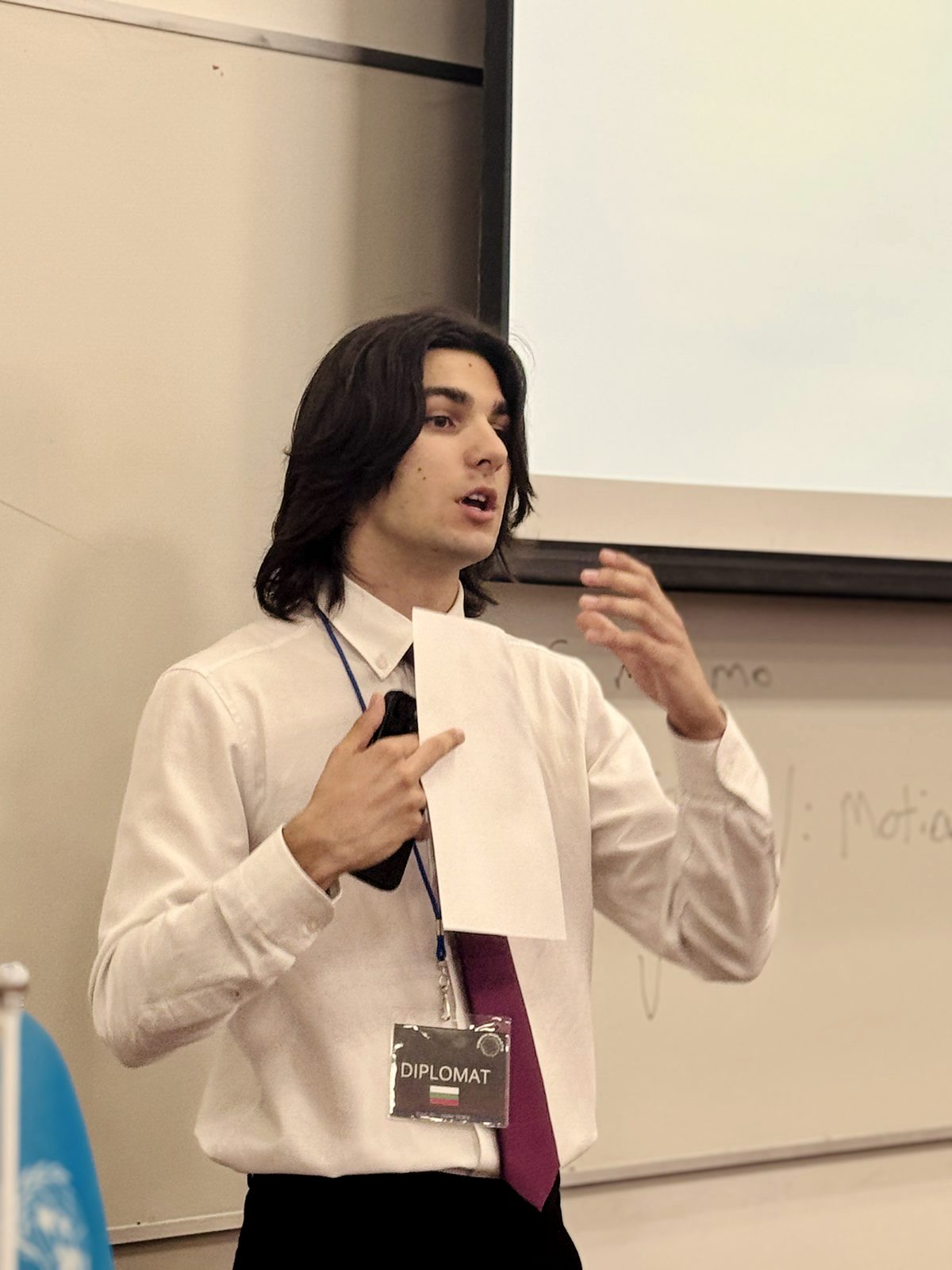
Model UN vs debate is a choice between two kinds of argument: Model UN asks you to represent a country's position and negotiate a written agreement with a room of other delegates, while competitive debate asks you to defend an assigned side against one opponent and win a judge's decision. Both build public speaking; they differ in almost everything else.
Key takeaways
- Model UN is collaborative and diplomatic; debate is adversarial and decided by a judge.
- Debate builds faster argument construction and rebuttal; Model UN builds negotiation, coalition-building and drafting.
- Debate is usually less expensive and more frequent; Model UN conferences cost more but happen a few times a year.
- Neither is better for university applications in itself; what matters is depth, progression and what you can say about it.
- Mock trial is a third option, closer to debate in format but built around evidence and courtroom procedure.
- Many strong students do both, typically debate weekly and Model UN a few weekends a year.
What is the difference between Model UN and debate?
The difference between Model UN and debate is that Model UN simulates diplomacy and debate simulates a contest. Model United Nations (Model UN, MUN) is a simulation in which each student represents a country in a committee modelled on a United Nations body, speaks to that country's position, and works with others to draft and pass a resolution. Competitive debate, in formats such as British Parliamentary, Lincoln-Douglas, Public Forum or World Schools, sets two sides against each other on a motion, with a judge deciding who argued better.
The practical consequence is that a Model UN session can end with most of the room satisfied, because the goal is an agreement, while a debate round always ends with a winner and a loser. That single fact shapes the skills, the temperament and the culture of each activity.
Neither is a lesser version of the other. If you are weighing Model UN on its own merits, our piece on whether Model UN is worth it takes an honest look; this article is about the comparison.
Formats side by side
The clearest way to see the Model UN or debate club question is to lay the two formats next to each other.
| Model UN | Competitive debate | |
|---|---|---|
| Basic unit | A committee of anywhere from a dozen to a couple of hundred delegates, each representing a country | A round between two teams or two individuals |
| Your position | Your assigned country's real policy | The side you are assigned, for or against a motion |
| Goal | Pass a resolution your bloc supports | Win the judge's decision |
| Length | A conference: one day to a long weekend, several sessions of two to three hours | A round: typically 40 to 90 minutes; a tournament: a day or two |
| Speaking | Short speeches of 60 to 90 seconds, plus informal negotiation | Timed constructive speeches and rebuttals of 4 to 8 minutes |
| Written output | Position paper before; working papers and draft resolutions during | Case files and flows; nothing formally adopted |
| Who decides | The committee, by vote; awards from the chairs | One or more judges |
| Preparation | Weeks of country and topic research before a set agenda | Ongoing case preparation; some formats give the motion minutes before |
| Dress | Western business attire | Varies; business attire at most tournaments |
Which skills does each build?
Debate builds speed of argument and rebuttal; Model UN builds negotiation, coalition-building and the discipline of writing something others will sign. Both build public speaking, research and composure under questioning.
What debate develops faster
- Argument structure: claim, warrant, impact, delivered under a strict clock.
- Rebuttal: listening to an opponent and dismantling the argument in real time.
- Thinking on your feet: especially in formats where the motion is announced shortly before the round.
- Volume of practice: a debater may speak in several rounds a week.
What Model UN develops faster
- Negotiation: finding the clause that three blocs can live with. The free negotiation tactics module covers the core moves.
- Coalition-building: persuading twenty people, not one judge, through lobbying and caucusing.
- Drafting: operative clauses, amendments and the language of compromise.
- Representing a view you do not hold: a country's policy is not your opinion, and learning to argue it well is the point.
- Institutional literacy: how the United Nations, its committees and its resolutions actually work.
Employers notice the difference. Our article on the Model UN skills employers value explains why negotiation and drafting show up so often in job descriptions.
Time commitment and cost
Debate usually demands more time each week and less money; Model UN demands less time week to week and more money per event. Debate clubs typically meet once or twice a week with tournaments on weekends through a season, and the costs are entry fees and local travel. Model UN clubs meet less often, but a residential conference means registration fees, travel and accommodation, all at once.
Costs vary so widely by school, region and conference that no single figure is honest. A school-hosted Model UN conference may cost little more than lunch; a residential conference in a major city can run into the low thousands once flights and hotel are counted. Our guide to how much Model UN costs breaks the numbers down. For comparison, The Global 60 in New York is $2,999 on its Delegate tier, covering three nights' accommodation, all meals, transfers and the full programme, with flights, visas and insurance not included.
A rule of thumb
If your weekends are already full, Model UN's few-times-a-year rhythm may fit better; if you want a weekly discipline with constant feedback, debate is built for it.
How competitive is each?
Debate is competitive by design, with rankings, brackets and eliminations at every tournament, whereas Model UN is competitive at the margins, with awards given in each committee but most of the room going home without one and not minding much. That difference is temperament as much as structure.
In debate, the score is the point, and improvement is measurable from one tournament to the next. In Model UN, awards such as Best Delegate, Outstanding Delegate and Honourable Mention recognise a mix of research, speaking, negotiation and conduct, judged by chairs over a whole conference. They matter less than debaters assume and more than beginners expect; our explainer on Model UN awards covers how they are decided.
Committee size also changes how competitive a conference feels. In a chamber of twenty, everyone speaks and everyone is seen; in a room of two hundred, only a handful ever hold the floor. That is why The Global 60 runs three small chambers of approximately twenty delegates each rather than a single large assembly.
Which is better for college applications?
Neither Model UN nor debate is better for college applications in itself; admissions readers respond to depth, progression and reflection, not to the name of the activity. Four years of debate with a clear arc from novice to captain reads as well as four years of Model UN with the same arc, and either reads better than a year of both done lightly.
What each looks like on an application
- Debate offers measurable results: records, rankings, qualification to state or national tournaments. It reads as rigour, quick thinking and resilience.
- Model UN offers narrative: a country you came to understand, a resolution you drafted, a coalition you held together, a committee you later chaired. It reads as diplomacy, research and leadership among peers.
- Both gain from a supporting essay or interview story that shows what you learned, which is why the reflective habit matters more than the trophy.
Our guide to Model UN on college applications goes into how to describe the activity without exaggeration; the same principles apply to debate.
What about mock trial?
Mock trial is a third option, closer to debate in format but built around evidence, witnesses and courtroom procedure rather than a motion. Teams prepare a fictional case for months, taking the roles of attorneys and witnesses, then present it before a judge and scoring panel under rules of evidence.
Compared with MUN, mock trial is more scripted and more adversarial, with a single case per season rather than a new agenda per conference. Compared with debate, it rewards preparation and performance over improvisation. It suits students drawn to law, to precision, and to team roles that range from lead counsel to a witness who must stay in character under cross-examination. On applications it reads much like debate, with the added signal of sustained teamwork on one case.
Who suits Model UN, and who suits debate?
Model UN suits students who enjoy people, research and building agreement; debate suits students who enjoy argument, speed and a clear result.
You may prefer Model UN if you
- Like the long game: weeks of research on one topic, then days of negotiation.
- Prefer persuading a room to defeating an opponent.
- Enjoy writing and want your words in a document others adopt.
- Are curious about how the world is governed and want to travel to conferences.
You may prefer debate if you
- Want frequent, measurable feedback and a season with a scoreboard.
- Think fastest under pressure and enjoy rebuttal more than compromise.
- Have limited budget for travel and want an activity that runs weekly close to home.
- Enjoy one-to-one or small-team competition rather than committee dynamics.
Introverts, for what it is worth, do well in both. Model UN gives quieter students informal caucusing, where much of the real work happens; debate gives them a fixed structure that removes the guesswork about when to speak.
How to do both
The most common way to do both is to debate weekly and attend Model UN conferences a few weekends a year, letting each feed the other. Debate sharpens the speeches you give in committee; Model UN teaches the debater to find common ground and to write.
- Pick a primary. Commit to one as your weekly discipline for at least a year, so that depth shows on your record.
- Add the other seasonally. Two or three Model UN conferences a year fit around a debate season; a debate summer intensive fits around Model UN.
- Carry skills across deliberately. Use debate's argument structure in your Model UN opening speech; use Model UN's drafting habits to tighten your debate cases.
- Do not double-book a term. A missed tournament and a half-prepared position paper help neither.
For a debater trying a first conference, the free Youth Impacts modules on rules of procedure and how to write a position paper cover the two things debate will not have taught you. No Model UN experience is required to apply to The Global 60, and a strong debater with a curious mind is exactly the kind of applicant its interview is designed to recognise.
Where to go next
If Model UN sounds like your format, start with the free Youth Impacts training curriculum, then read how to choose a Model UN conference. If you want to see what a small, well-run Model UN looks like, The Assembly explains the three chambers of The Global 60, and the admission page describes how to apply.
Frequently asked questions.
What is the main difference between Model UN and debate?
Model UN simulates diplomacy: you represent a country's position and negotiate a resolution with a committee. Debate simulates a contest: you defend an assigned side against an opponent and a judge decides who argued better.
Is Model UN or debate better for college applications?
Neither is better in itself. Admissions readers respond to depth, progression and reflection. Debate offers measurable results; Model UN offers a narrative of research, negotiation and leadership among peers.
Which is more expensive, Model UN or debate?
Model UN usually costs more per event because residential conferences involve registration, travel and accommodation; debate costs less per event but takes more time each week. Costs vary widely by school and region.
How is mock trial different from Model UN?
Mock trial is a courtroom simulation built around evidence, witnesses and procedure, with one case prepared over a season. Model UN is a diplomatic simulation with a new agenda each conference and a negotiated resolution as the goal.
Can I do both Model UN and debate?
Yes. The usual pattern is to debate weekly and attend a few Model UN conferences a year, choosing one as your primary so that depth shows on your record.
Do I need debate experience to apply to The Global 60?
No. No Model UN or debate experience is required. Applicants are assessed on curiosity, the ability to hold a position, listening and motivation in a short application and, for shortlisted applicants, a fifteen-minute video interview.

Youth Impacts is a Model United Nations organisation. Its flagship New York experience is The Global 60: sixty delegates, three small chambers, 22 – 25 April 2027, admission by application and interview. Youth Impacts Model United Nations (YIMUN) has run since 2025. Questions: info@youthimpacts.com. Published 19 September 2026.