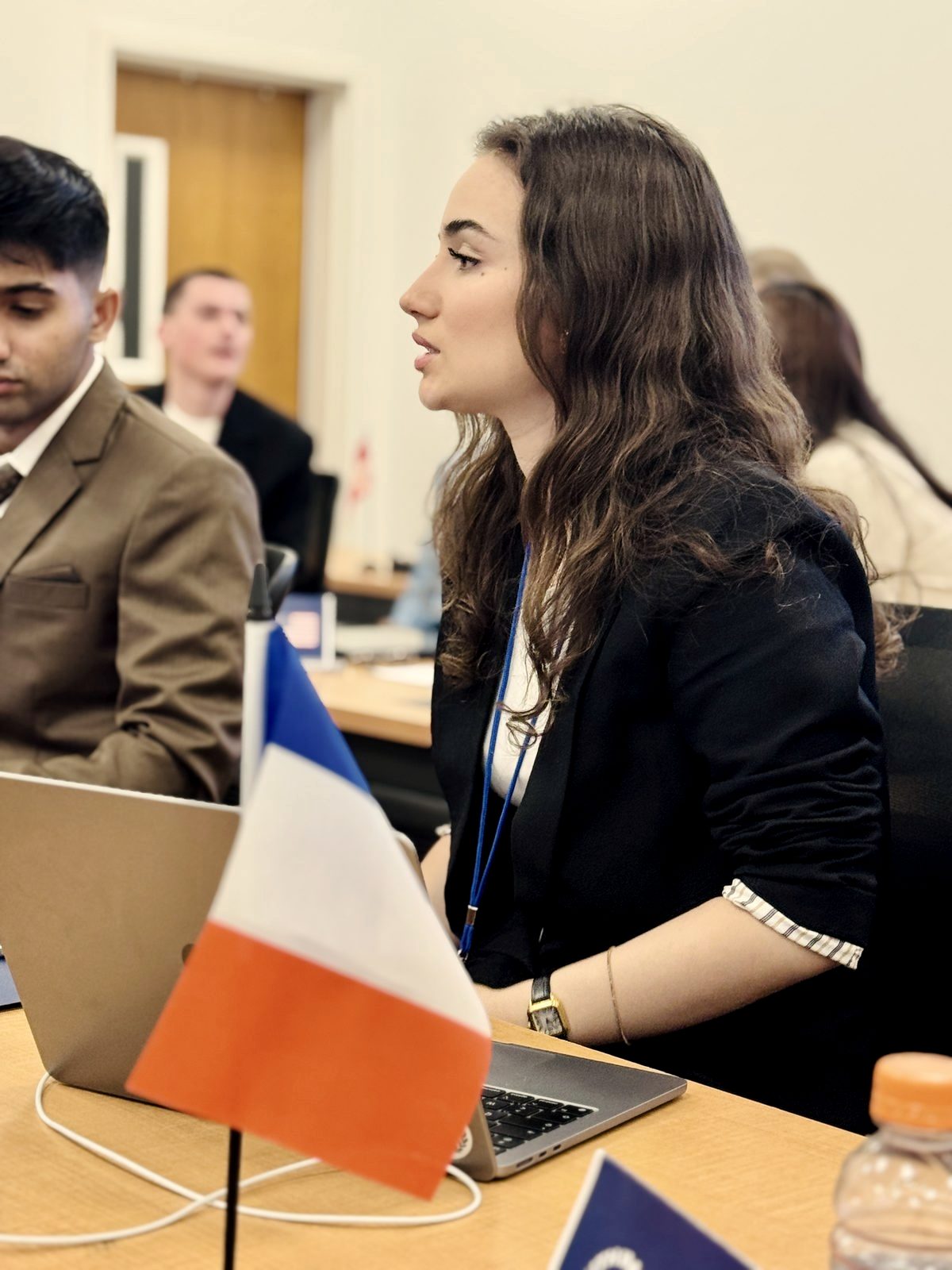
At your first Model UN conference, expect a fixed sequence: arrival and registration, a short opening, a first committee session of opening speeches, caucusing, working papers, a draft resolution, amendments and a vote, then a closing. Knowing what to expect in each phase, and the mistake beginners make in it, is most of the preparation.
Key takeaways
- Every Model UN conference follows the same arc from opening speeches to a vote, so you can prepare for each phase before you arrive.
- The most common beginner mistake is silence in the first session; the second is joining a bloc without reading its text.
- Caucusing, not formal debate, is where most of the work happens.
- A working paper becomes a draft resolution only when it has enough sponsors and the chair accepts it; know the difference.
- Pack for two dress codes, long days and a hotel room you will barely see.
- What happens at a Model UN conference?
- Before you go: the brief and the position paper
- Arrival, registration and the opening
- Committee Session I: roll call and opening speeches
- Caucusing: where the work happens
- Working papers and draft resolutions
- Voting, the plenary and the closing
- Packing checklist for a first Model UN conference
- Where to go next
What happens at a Model UN conference?
A Model UN conference puts students into committees where each represents a country, debates an assigned topic under formal rules and tries to pass a resolution. Model United Nations (Model UN, MUN) is a simulation of bodies such as the General Assembly committees or the Security Council; the chair runs procedure, the delegates do the rest.
The shape of a Model UN schedule is consistent even when the length varies. The Global 60, Youth Impacts' New York programme on Thursday 22 – Sunday 25 April 2027, uses a Thursday to Sunday shape that makes a good example. Thursday is arrival and a welcome reception, not a conference day. Friday is a half day, "The Room", with a preparation session and Committee Session I. Saturday, "The World", carries Committee Session II, the Founder Lab and the gala. Sunday, "The Legacy", holds the final session, the Global Plenary and recognition. Three nights, two and a half days of programme. Longer conferences add sessions; the order rarely changes.
Before you go: the brief and the position paper
Before the conference you need three things: your country assignment, the background guide for your committee, and a position paper stating your country's view on each topic. The organiser sends the first two; you write the third.
Read the background guide twice and follow its references to the primary sources it cites, usually UN resolutions and reports. Then write one page per topic: the problem as your country sees it, what your country has done, what it wants the committee to do. The free guide to writing a position paper and the 30-day preparation plan take you through it.
What beginners get wrong
Writing the position paper about their own opinions rather than their country's interests, and arriving without a single prepared speech. Draft your opening speech at home; you will not have time on the day.
Arrival, registration and the opening
On arrival you register, collect your credential and any materials, find your room if the conference is residential and attend an opening that ranges from a full ceremony to a few short remarks. The opening ceremony is where the secretariat is introduced and, at some conferences, guest speakers address the whole delegation.
Use the arrival period to meet the delegates in your committee before anyone is in role. At The Global 60, Thursday is built for exactly this: a welcome desk, portraits and a hosted reception where remarks stay under twenty minutes. The conference itself opens on Friday afternoon with a short film rather than long speeches, followed by a preparation session on procedure, speaking and drafting before the chambers sit for the first time.
What beginners get wrong
Treating arrival as dead time. The delegates you talk to at the reception are the first members of your bloc. Learn names and countries, not just faces.
Committee Session I: roll call and opening speeches
The first committee session begins with roll call, the setting of the agenda and the opening of the general speakers' list, on which each delegate gives a short speech, usually sixty to ninety seconds, stating their country's position. This is the one moment every delegate is guaranteed a hearing, so use it.
Say your country's name, name the problem, state your position and signal whom you want to work with. Sit down before the chair asks you to. Our guide to the Model UN opening speech gives a structure, and the free module on rules of procedure explains the motions you will hear around you: to set the agenda, to open the speakers' list, to move into caucus.
What beginners get wrong
Not putting their placard up. If you are not on the speakers' list you will not speak, and in a large committee the list may close before you find your nerve. Raise it in the first minute.
Caucusing: where the work happens
Caucusing is the informal negotiation that takes place between speeches, and it is where most of the substance of a Model UN conference is decided. A moderated caucus is a short, focused debate on one sub-topic with brief speaking times; an unmoderated caucus suspends formal rules entirely so delegates can leave their seats, form groups and write.
In unmoderated caucus, find the delegates whose speeches matched yours, agree on two or three things you all want, and start writing them down. Bring a laptop or paper and be the person holding the pen. The free module on lobbying and caucusing covers the detail, including how to count votes before you need them.
What beginners get wrong
Wandering. A delegate who spends unmoderated caucus circulating between six groups ends the session in none of them. Choose a bloc early and commit to the text.
Working papers and draft resolutions
A working paper is a bloc's informal document of ideas; it becomes a draft resolution when it is written in proper clause format, has the required number of sponsors and signatories and is formally introduced by the chair. Sponsors wrote it and support it; signatories only want it debated.
Resolutions have a fixed grammar: preambular clauses that set out context and operative clauses that say what the committee decides, each beginning with an approved verb. Once introduced, drafts are debated and amended; friendly amendments are accepted by all sponsors, unfriendly ones are voted on. The draft resolution guide shows the format line by line. Read the whole draft before you sign it; you will be asked to defend it.
What beginners get wrong
Signing every paper they are handed and sponsoring none. A signature costs nothing, but a sponsor line is a record of work you did. Write at least one operative clause yourself and make sure it survives.
Voting, the plenary and the closing
In the final session the committee closes debate, votes on amendments and then on each draft resolution in turn, and either adopts or rejects them; the conference then ends with a closing session where outcomes are presented and awards announced. Voting may be by placard or, if a delegate calls for it, by roll call, and drafts need a simple majority unless the committee's rules say otherwise.
At The Global 60, the Sunday morning holds the final committee session, then the Global Plenary in which all sixty delegates return to one room and each chamber's outcomes are presented, then a closing brunch and recognition. Awards per chamber are Best Delegate, Outstanding Delegate, Honourable Mention and Best Position Paper. Our explainer on how Model UN awards work covers what chairs look for.
What beginners get wrong
Switching off after the vote. The closing is where you collect feedback, exchange contact details and thank your chair, and it is the last time you will have that room in one place.
Packing checklist for a first Model UN conference
Pack for business attire in committee, any formal evening on the programme, long days and a small amount of downtime. The list below covers a residential conference of three or four nights; adjust for a day event.
Committee
- Business attire for every committee day: suit or jacket with trousers or skirt, shirts, one pair of comfortable formal shoes. See what to wear to Model UN.
- Your position paper, printed and on your laptop, with your opening speech and a one-page brief on your country.
- Laptop or tablet and charger, plus a paper notebook and two pens for when devices are not allowed in caucus.
- The background guide, annotated, and the committee's rules of procedure.
Evening and travel
- Formal wear if the programme includes a gala: The Global 60's Saturday gala is black tie, and our black-tie guide explains what that means in practice.
- Smart casual clothes for arrival, a reception and travel days.
- Passport, visa documents and insurance details, plus the organiser's emergency contact, printed.
- Medication and any consent forms the organiser requires, and a small amount of local currency.
- A refillable water bottle and snacks; committee sessions run long and breaks are short.
What beginners get wrong
One suit for three days and no second pair of shoes. Committee rooms are warm, the days are long and photographs are taken constantly; pack a change of shirt for each day.
Where to go next
If you would like your first conference to be a small room where you speak in every session, read about The Assembly at The Global 60, the full Thursday to Sunday programme and the admission process; no Model UN experience is required to apply. For the fundamentals before any conference, start with the free Youth Impacts training curriculum.
Frequently asked questions.
What happens on the first day of a Model UN conference?
Registration, an opening that may be a full ceremony or a few short remarks, and usually the first committee session, which begins with roll call, the setting of the agenda and opening speeches from each delegate.
What is the difference between a moderated and an unmoderated caucus?
A moderated caucus is a short, focused formal debate on one sub-topic with brief speaking times. An unmoderated caucus suspends the formal rules so delegates can leave their seats, form blocs and write together.
What should a beginner prepare before a Model UN conference?
Read the background guide twice, write a one-page position paper per topic from your country's point of view, and draft your opening speech at home. Learn the basic motions from the rules of procedure.
How long is a Model UN conference?
Anything from a single day to several days. The Global 60 runs Thursday to Sunday in New York: three nights, with two and a half days of programme, the Thursday being an arrival day rather than a conference day.
What should I pack for a Model UN conference?
Business attire for every committee day with a change of shirt each day, formal wear if there is a gala, your position paper and speech printed and on a laptop, chargers, a notebook, travel documents, insurance details, medication and a water bottle.

Youth Impacts is a Model United Nations organisation. Its flagship New York experience is The Global 60: sixty delegates, three small chambers, 22 – 25 April 2027, admission by application and interview. Youth Impacts Model United Nations (YIMUN) has run since 2025. Questions: info@youthimpacts.com. Published 19 September 2026.